

Central Vietnam
Hội An
Ancient town, living culture
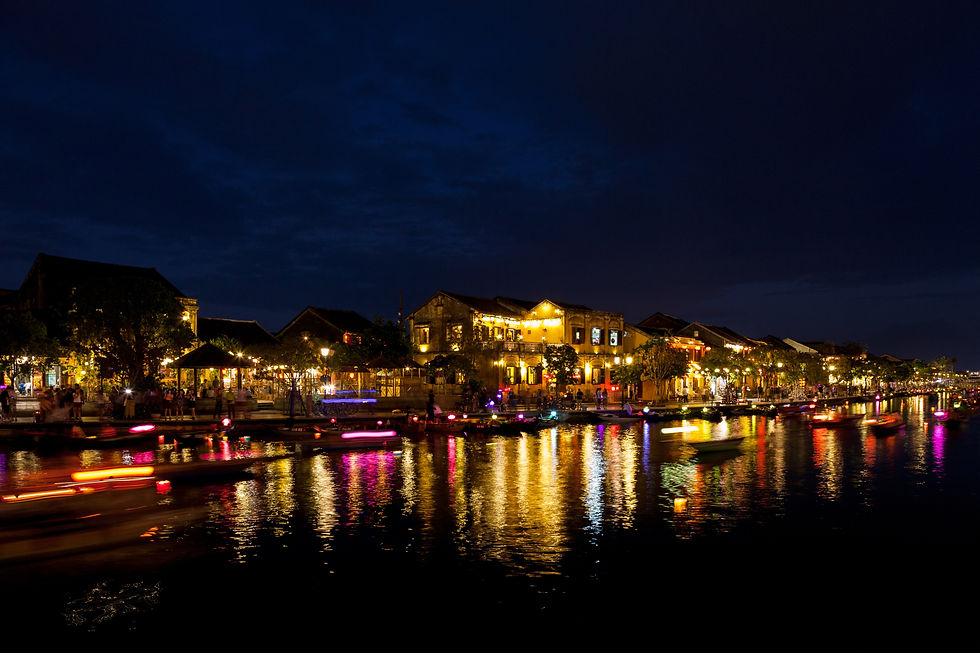
Floating lanterns reflected in the river at dusk, Hội An Old Town
Long before it was a port, this stretch of coast belonged to Champa — Cham seafarers were trading here for centuries before anyone in Europe had heard of Vietnam. What became Hội An came later, when the Nguyễn lords opened the harbor to foreign ships in the 16th century and merchants from Japan, China, Portugal, Holland, and beyond built a town to work from rather than just pass through. The Japanese who settled here in the 1590s left the town's most photographed landmark: the Covered Bridge, built — so the story goes — as a sacred sword driven into the back of a giant sea monster whose head lay in India, body in Vietnam, and tail in Japan, thrashing out earthquakes wherever it moved. A small Taoist shrine still sits at the bridge's center, keeping the creature still.
By the 18th century Hội An — Western traders called it Faifo — was one of the busiest ports in Southeast Asia, its warehouses moving silk, ceramics, and spices between Asia and Europe. Then the Thu Bồn River silted up, boats stopped calling, and nearby Đà Nẵng took the trade Hội An used to hold. That decline is what saved it — nothing left to tear down and rebuild. UNESCO recognized what survived in 1999: Chinese merchant houses, Japanese architecture, and French colonial facades, still standing side by side on streets that have barely changed in three hundred years.
But what makes Hội An extraordinary isn't what's been preserved. It's what's still alive inside it. The tailors still sew, the lantern makers still fold, the fishermen still set their nets on the Thu Bồn River before dawn. This is a town that hasn't become a museum of itself — yet.
February to April for dry weather and mild temperatures. Avoid October and November when the Thu Bon River floods parts of the Old Town.
Fly into Đà Nẵng International Airport — 30 minutes south by taxi. Direct connections from Hanoi, Ho Chi Minh City, Singapore, Kuala Lumpur, and Bangkok.
GETTING THERE
BEST TIME TO VISIT
Hội An Market & Night Lantern Cruise
2 hours
Hội An's market at its most unguarded hour, then the town's lantern-lit skyline seen the way it's meant to be — slowly, from a private boat after dark.

Kayak Hội An Waterway
2 hours
Mangrove tunnels where the sky disappears, fish traps set at dawn, egrets lifting from reed beds — the Hội An most visitors see only from a bus window, experienced at paddle pace with no experience required.

Hoi An: Village Life by Bicycle
3.5 – 4 hours
Cycle to villages with no guesthouses, make noodles by hand in a family home, eat what they cook, then float back to Old Town on a private boat.

Mỹ Sơn Sanctuary
5 hours
A civilisation older than Angkor, a guide who makes the carved stones speak, and a valley so quiet you can hear the monsoon history in it — Mỹ Sơn on foot with the right guide is one of Southeast Asia's great heritage encounters.

Hoi An: Coffee with an Award-Winning Barista
2 hours
He sources, ferments, and roasts his own beans, then explains why milk coffee lives or dies in a two-degree window. You'll never look at a flat white the same way.

Hoi An: Cooking with Chef Hoang
3 hours
He gave up a marketing career for a hotel kitchen, then gave up the hotel kitchen for his mother's recipes. You get both versions of him in one class.

Hoi An: Basket Boat, Sunset Cruise & Dinner
3-4 hours
Basket boat through quiet countryside channels, dinner on a slow wooden boat as the light drops, then Old Town's lantern-lit skyline arriving from the water.

Hoi An: Street Food Tour on Foot
3 hours
Cao lầu made with water from one specific well, white rose dumplings only a handful of families still fold — eaten with the stories attached.
